The first time I saw it, I thought it was a one-off. A dog caught sight of our van from half a block away and started shaking. Not excited-shaking. The low, full-body kind. By the time we got him inside, he'd already had an accident on the floor.
It wasn't a one-off. It happens more than most pet parents will ever know, because it happens before they've handed the leash over, and it happens quietly enough that nobody thinks to mention it.
Here’s the thing I’ve learned after years of being a pet parent and one year of running a business in this industry: it's not that pet owners don't love their dogs and cats. It's that almost nobody has ever told them what actually happens during a groom, or what to watch for. The industry has never had to explain itself, so it hasn't.
A client once came to us wanting a specific, tidy cut for her dog. Reasonable request, except the dog hadn't been groomed in a long time and was matted through most of his coat. At that point there are really only two honest options: leave the mat and skip the haircut, or de-mat him, which is uncomfortable at best and painful at worst depending on how tight the mats have pulled.
There's a third option, and it's the one we actually recommend: trim the coat shorter now, start a daily brushing routine, and build toward the haircut she wanted over the next few sessions, once the coat and the dog can both handle it. It takes longer. It's not as instantly satisfying. But it doesn't put the dog through unnecessary pain for the sake of one appointment.
Most owners don't know that third option exists, because most groomers won't take the time to offer it, and most owners have never had a reason to ask.
That's also usually the moment we get asked why the groom takes two hours when the place down the street does it in under one. It's a fair question. It just doesn't have a fast answer, and "we take longer because we're paying attention to your dog the whole time" doesn't fit on a price list.
Here's what actually unsettles me, more than rushed timelines, more than price comparisons. Every so often, a dog or cat gets overwhelmed mid-groom. We stop. That's the whole point of stopping: it's a signal, and we listen to it.
Some owners, in that moment, step in and say "let me handle him," and then handle him with exactly the kind of physical force we'd just paused to avoid. It's not malice. It's that somewhere along the way, "just hold him still" became the accepted default for a stressed animal, because nobody ever offered an alternative. If the industry itself hasn't questioned that norm, why would the person paying for a haircut know to?
That's the real gap. Not bad owners. An industry that never explained the difference.
Every week, we get calls that start with "just be careful with his nails, last time he had a bad experience," or "go slow with the clippers, he might react." Those calls are proof of something: these animals are carrying memory of past grooms, and it's shaping how they experience every one after.
We started testing something during the interviews: showing groomers photos and clips of dogs and asking them to read the animal's state. Almost every time, the only signal recognized is a growl. But a growl is late-stage. Long before that, there's lip-licking, a tucked tail, ears pinned back, whale-eye, a stiff freeze. A dog can't say "stop." It says it with all of this first, and if nobody's trained to see it, the groom just keeps going until the growl finally forces a reaction.
That's the actual root problem. Not rushing, exactly. A groomer who could read those early signs wouldn't need to rush past them, because they'd know to slow down before it got there. The rushing is a symptom. The illiteracy is the disease.
Cats are a clear example. Most cats don't want a shower, so we don't do it as a default. We bathe a cat when a client specifically asks for it, and when we do, we take every precaution we can, because the real danger isn't the water. It's what happens right after: a wet cat, suddenly cold, can associate that discomfort with the whole experience.
So we keep her warm through it. Body heat, a heating pad under a towel. She's never left uncovered for the air to hit her directly.
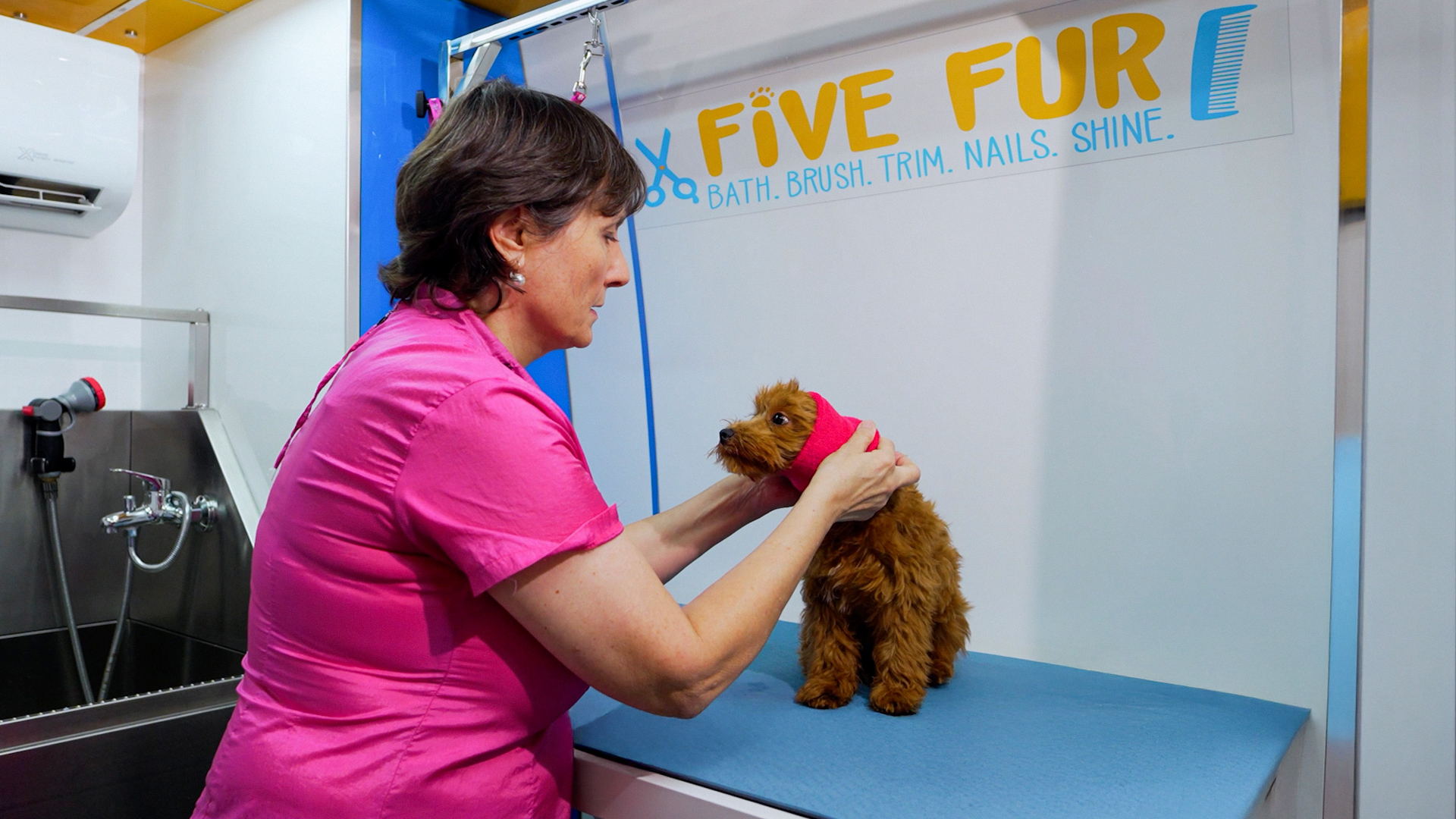
Drying is where a lot of standard grooming gets rough: high-powered force dryers, fast, loud, done. We use hand dryers instead, ear protection to soften the sound, and we go at the pace the animal's body language tells us to go, which is exactly why our sessions run longer than the industry average. That extra hour isn't padding. It's the whole difference.
If you read one thing into this, let it be a question, not a judgment of yourself: what does your groomer do when your dog gets stressed mid-appointment? Do they stop? Would they tell you if they did? What happens in the time you're not in the room?
A cheap, fast, good-looking groom can still be a bad experience for the animal underneath it, and you may not find out until your dog starts shaking at the sight of a van, or your cat stops trusting hands near her paws. That change is real, and it's permanent, and it's almost never caused by one dramatic incident. It's built from a dozen small, silent ones.
Ask your groomer more questions. Ask what happens when your pet gets scared. If the answer is vague, that's the answer.


We bring gentle, stress-free pet grooming to your doorstep - with expert care, safe products and total transparency.


.svg)

.svg)